Mathematics 10-3
Study Guide — Combined Final Exam Review
How to Use This Guide
This guide follows the Alberta Math 10-3 program (ADLC Units A–D, Workbooks 1–8). Work through one unit at a time: read the lesson, try the examples, then do the practice set and check the answer key.
Study plan
- 1Read the unit overview at the start of each unit.
- 2Work through one section (e.g. 3.1). Use the diagram if there is one.
- 3Try each example before reading the solution.
- 4Do the practice questions and check the answer key.
- 5Take a short break between sections if you need one.
- 6After all 7 units, write the practice final exam in one sitting (about 2 hours, calculator allowed).
Exam Strategies
Before the combined final
- Calculator in DEGREE mode for trigonometry
- Formula sheet ready to use
- Pencil, eraser, scrap paper ready
- All 7 units studied — see Course Map for workbook alignment
Read each question twice. Underline what is asked. Circle the numbers given. Write the formula first, then substitute. Include units in every answer. Do easy questions first — every question earns marks.
Course Map — ADLC Alignment
The ADLC course has 4 units (A–D) and 8 workbooks. This guide uses a 7-unit order but covers the same material. Fin has one combined final exam — all units below are on that exam.
Guide = main units. Supp = supplement sections at the back.
Guide Unit 2 §2.1–2.4 · Supp §2.5–2.6
Guide Unit 1 §1.1–1.4 · Supp §1.5–1.6
Guide Unit 7 §7.2 · Supp §7.7
Guide Unit 7 §7.1, 7.3–7.6 · Supp §7.8
Guide Unit 3 §3.1–3.2 · Unit 4 §4.1–4.3
Guide Unit 5 §5.1–5.3 · Supp §5.4–5.5
Guide Unit 3 §3.3–3.6 · Supp §3.7–3.8
Guide Unit 6 §6.1–6.3 · Supp §6.4
One combined final exam covers all 7 guide units and all 8 workbooks. Study every unit before exam day. ADLC also requires 2 of 4 "Keeping It Real" projects (not in this guide).
Formula Sheet
These are the essential formulas for the whole course. Practise until you can use each one without looking.
Essential formulas — Math 10-3
| Topic | Formula |
| Unit price | unit price = total price ÷ number of units |
| Sale price | sale price = regular price × (1 − discount rate) |
| Price with GST (Alberta) | total = price × 1.05 |
| Markup | selling price = cost × (1 + markup rate) |
| Proportion | if a/b = c/d then a × d = b × c |
| Gross pay (hourly) | pay = hours × rate (overtime usually × 1.5) |
| Net pay | net pay = gross pay − total deductions |
| Perimeter of rectangle | P = 2(l + w) |
| Circumference | C = πd = 2πr |
| Area (rectangle) | A = lw |
| Area (triangle) | A = bh ÷ 2 |
| Area (circle) | A = πr² |
| Surface area (box) | SA = 2(lw + lh + wh) |
| Surface area (cylinder) | SA = 2πr² + 2πrh |
| Volume (prism) | V = lwh |
| Volume (cylinder) | V = πr²h |
| Temperature | °F = 1.8°C + 32 · °C = (°F − 32) ÷ 1.8 |
| Pythagorean theorem | a² + b² = c² |
| Trig ratios | sin θ = opp/hyp · cos θ = adj/hyp · tan θ = opp/adj |
1 in = 2.54 cm · 1 ft = 12 in · 1 m ≈ 3.28 ft · 1 mi ≈ 1.609 km
1 kg ≈ 2.2 lb · 1 lb = 16 oz · 1 oz ≈ 28.35 g
1 US gal ≈ 3.79 L · 1 cup = 250 mL · 1 mL = 1 cm³
Unit 1: Unit Pricing and Currency Exchange
This unit is about being a smart consumer: comparing prices, understanding discounts and markups, calculating sales tax, and exchanging currency for travel.
1.1 Proportional Reasoning
A ratio compares two quantities, such as 250 km driven on 20 L of gas. A proportion is a statement that two ratios are equal. Proportions are the main tool in this course — they appear in pricing, currency exchange, scale drawings, and similar triangles.
To solve a proportion, use cross-multiplication: if a/b = c/d, then a × d = b × c.
Example 1.1 — Solving a proportion
A car uses 20 L of gas to travel 250 km. How much gas is needed to travel 400 km?
Solution:
Set up the proportion: 20 / 250 = x / 400
Cross-multiply: 250 × x = 20 × 400
250x = 8000, so x = 8000 ÷ 250 = 32
The car needs 32 L of gas.

1.2 Unit Price and Comparison Shopping
The unit price is the cost of one unit of a product — one litre, one kilogram, one can. Comparing unit prices tells you which package is the better buy.
Example 1.2 — Finding a unit price
A 4 L jug of milk costs $6.28. What is the price per litre?
Solution:
Unit price = $6.28 ÷ 4 = $1.57 per litre
Example 1.3 — Which is the better buy?
Cereal comes in a 400 g box for $4.29 or a 750 g box for $6.99. Which is the better buy?
Solution:
400 g box: $4.29 ÷ 400 = $0.0107 per gram (1.07¢/g)
750 g box: $6.99 ÷ 750 = $0.0093 per gram (0.93¢/g)
The 750 g box has the lower unit price, so it is the better buy.
Remember that unit price is not the only thing that matters. A bigger package is not the better choice if part of it will spoil before you use it.
1.3 Percent, Discounts, and Sales Tax
To find a percent of a number, change the percent to a decimal and multiply. For example, 30% of $89.99 is 0.30 × 89.99.
Discount: amount saved = regular price × discount rate. Sale price = regular price − discount. Shortcut: a 30% discount means you pay 70%, so sale price = regular price × 0.70.
Sales tax: in Alberta the only sales tax is the 5% GST. Price with GST = price × 1.05. (Other provinces add PST or use HST, so totals are higher there.)
Markup: stores buy at a wholesale cost and mark it up to set the selling price. Selling price = cost + markup = cost × (1 + markup rate).
Example 1.4 — Sale price with GST
A jacket has a regular price of $89.99 and is on sale for 30% off. What is the total cost including 5% GST?
Solution:
Discount = 0.30 × $89.99 = $27.00
Sale price = $89.99 − $27.00 = $62.99
Total with GST = $62.99 × 1.05 = $66.14
Example 1.5 — Markup
A store buys a backpack for $15.00 and applies a 60% markup. What is the selling price?
Solution:
Selling price = $15.00 × (1 + 0.60) = $15.00 × 1.60 = $24.00
1.4 Currency Exchange
An exchange rate tells you how much one currency is worth in another. For example, if 1 CAD = 0.74 USD, then every Canadian dollar buys 74 US cents.
Banks use two rates: they sell foreign currency to you at a higher rate and buy it back at a lower rate. The difference is how they make money, so converting money back and forth always costs you something.
Example 1.6 — Canadian dollars to US dollars
Jared is travelling to Montana. The exchange rate is 1 CAD = 0.74 USD. How many US dollars will he get for 500 CAD?
Solution:
500 × 0.74 = 370.00
Jared receives 370.00 USD.
Example 1.7 — US dollars back to Canadian dollars
After the trip Jared has 200 USD left. The bank buys US dollars at 1 USD = 1.35 CAD. How many Canadian dollars does he get?
Solution:
200 × 1.35 = 270.00
Jared receives 270.00 CAD.
Unit 1 Practice Questions
Round money to the nearest cent. Answers are in the Answer Key at the back.
A 3 kg bag of rice costs $8.67. Find the price per kilogram.
Shampoo comes in a 500 mL bottle for $4.50 or a 750 mL bottle for $6.30. Which is the better buy? Justify with unit prices per 100 mL.
A 12-pack of soda costs $5.88. What is the cost per can?
A shirt priced at $34.99 is on sale for 25% off. Find the sale price (before tax).
A video game costs $59.99. What is the total price in Alberta including 5% GST?
A store buys headphones for $22.00 and marks them up 45%. Find the selling price.
Convert 350 CAD to US dollars if 1 CAD = 0.73 USD.
Convert 100 euros to Canadian dollars if 1 EUR = 1.47 CAD.
A $120.00 item is discounted 15%, and then 5% GST is added. Find the final total.
A tool set regularly sells for $80.00 and is on sale for $60.00. What percent discount is this?
Unit 2: Earning an Income
This unit covers the different ways people are paid, how to calculate gross pay, and how deductions turn gross pay into the net pay (take-home pay) that actually lands in your bank account.
2.1 Ways of Earning Money
Hourly wage: paid a set amount per hour worked. Gross pay = hours × hourly rate.
Salary: paid a fixed amount per year regardless of exact hours. The annual salary is split into pay periods.
Commission: paid a percentage of what you sell. Some jobs pay straight commission; many pay a base salary plus commission.
Piecework: paid a set amount per item completed — per tree planted, per garment sewn, per kilometre driven.
Contract: paid a fixed total amount for completing a whole job.
Tips/gratuities: extra money from customers, added on top of a wage.
2.2 Pay Periods
An annual salary is divided by the number of pay periods in a year:
| Pay period | Pays per year | Calculation |
| Weekly | 52 | annual ÷ 52 |
| Biweekly (every 2 weeks) | 26 | annual ÷ 26 |
| Semi-monthly (twice a month) | 24 | annual ÷ 24 |
| Monthly | 12 | annual ÷ 12 |
Watch out: biweekly (26 pays) and semi-monthly (24 pays) are not the same thing. This is a favourite exam trap.
2.3 Overtime
Most jobs pay overtime after a standard number of hours (often 8 hours per day or 40 hours per week). The usual overtime rate is time-and-a-half (1.5 × regular rate); some jobs pay double time (2 × regular rate) for holidays.
Example 2.1 — Regular pay
Maria works 40 hours at $17.50 per hour. Find her gross pay.
Solution:
Gross pay = 40 × $17.50 = $700.00
Example 2.2 — Pay with overtime
Devon earns $16.00/h with time-and-a-half after 40 hours per week. One week he works 44 hours. Find his gross pay.
Solution:
Regular pay = 40 × $16.00 = $640.00
Overtime rate = $16.00 × 1.5 = $24.00/h
Overtime pay = 4 × $24.00 = $96.00
Gross pay = $640.00 + $96.00 = $736.00
Example 2.3 — Salary per pay period
Priya earns a salary of $52,000 per year, paid biweekly. Find her gross pay per cheque.
Solution:
Biweekly = 26 pay periods per year
Gross pay = $52,000 ÷ 26 = $2,000.00 per cheque
Example 2.4 — Salary plus commission
A salesperson earns $500 per week plus 2% commission on sales. One week she sells $12,000 worth of goods. Find her gross pay.
Solution:
Commission = 0.02 × $12,000 = $240.00
Gross pay = $500.00 + $240.00 = $740.00
Example 2.5 — Piecework
A tree planter is paid $3.25 per seedling and plants 185 seedlings in a day. Find the day’s earnings.
Solution:
Earnings = 185 × $3.25 = $601.25
2.4 Deductions and Net Pay
Gross pay is what you earn; net pay is what you take home after deductions. Common deductions:
CPP (Canada Pension Plan): a percentage of gross pay saved toward your government pension.
EI (Employment Insurance): a percentage of gross pay that funds benefits if you lose your job.
Income tax: federal and provincial tax, based on how much you earn.
Other: union dues, health plans, pension plans, charitable donations.
The exact CPP, EI, and tax rates change every year, so exam questions always give you the rates or the deduction amounts to use.
Example 2.6 — Calculating net pay
Liam’s gross pay is $1,200.00. His deductions are CPP at 5.95%, EI at 1.64%, and income tax at 15%. Find his net pay.
Solution:
CPP = 0.0595 × $1,200 = $71.40
EI = 0.0164 × $1,200 = $19.68
Income tax = 0.15 × $1,200 = $180.00
Total deductions = $71.40 + $19.68 + $180.00 = $271.08
Net pay = $1,200.00 − $271.08 = $928.92
Unit 2 Practice Questions
Ana works 37.5 hours at $15.80/h. Find her gross pay.
Marcus earns $18.00/h with time-and-a-half after 40 hours. He works 46 hours one week. Find his gross pay.
A salary of $58,500 per year is paid monthly. Find the gross monthly pay.
A salary of $61,200 per year is paid semi-monthly. Find the gross pay per cheque.
A realtor’s assistant earns 4% commission on $55,000 in sales. Find the commission.
A cell phone salesperson earns $600 per week plus 1.5% commission. Her sales were $40,000. Find her gross pay.
A worker sewing garments is paid $0.85 per garment and completes 640 garments. Find the gross pay.
Jade’s gross pay is $950.00. Deductions: CPP 5.95%, EI 1.64%, income tax 15%. Find her net pay.
A server works 8 hours at $15.00/h and earns $94.50 in tips. Find total earnings for the shift.
Kwame earns $22.40/h and works 40 hours a week, 52 weeks a year. Find his annual gross income.
Unit 3: Length, Area, and Volume
This unit covers measuring length in both the SI (metric) and imperial systems, converting between systems, and calculating perimeter, area, surface area, and volume.
3.1 The Two Measurement Systems
Canada officially uses the SI (metric) system, but the imperial system is still everywhere in the trades — lumber is sold in feet and inches, pipe fittings in fractions of an inch. A tradesperson must be comfortable with both.
| SI (metric) length | Relationship |
| millimetre (mm) | 10 mm = 1 cm |
| centimetre (cm) | 100 cm = 1 m |
| metre (m) | base unit |
| kilometre (km) | 1 km = 1000 m |
| Imperial length | Relationship |
| inch (in or ") | smallest common unit |
| foot (ft or ') | 1 ft = 12 in |
| yard (yd) | 1 yd = 3 ft |
| mile (mi) | 1 mi = 5280 ft = 1760 yd |
Common conversions between the systems (memorize the first one — the rest can be built from it):
1 in = 2.54 cm (exact)
1 ft = 30.48 cm ≈ 0.305 m
1 m ≈ 3.28 ft ≈ 39.37 in
1 mi ≈ 1.609 km
3.2 Reading an Imperial Ruler or Tape Measure
Imperial tapes divide each inch into halves, quarters, eighths, and sixteenths. The longest tick is the inch mark; each shorter tick is half the previous size. A measurement like 2 3/8" means 2 inches plus 3 of the eighth-inch spaces.
Always reduce fractions: 4/16 = 1/4, and 8/16 = 1/2. To add fractions of an inch, use a common denominator: 3/8 + 1/4 = 3/8 + 2/8 = 5/8.
Example 3.1 — Converting a height
Convert 5 ft 7 in to centimetres.
Solution:
First convert to inches: 5 ft × 12 = 60 in, plus 7 in = 67 in
67 in × 2.54 cm/in = 170.18 cm
Example 3.2 — Metres to feet
A ceiling is 3.5 m high. How high is that in feet?
Solution:
3.5 m × 3.28 ft/m = 11.48 ft ≈ 11.5 ft
3.3 Perimeter and Circumference
Perimeter is the total distance around a shape — add up all the sides. For a rectangle, P = 2(l + w). For a circle, the distance around is called the circumference:
Example 3.3 — Perimeter of a rectangle
A rectangular garden is 12.5 m long and 8.4 m wide. How much fencing is needed to enclose it?
Solution:
P = 2(l + w) = 2(12.5 + 8.4) = 2(20.9) = 41.8 m
Example 3.4 — Circumference
A circular table top has a diameter of 0.6 m. Find the circumference to the nearest hundredth.
Solution:
C = πd = π × 0.6 ≈ 1.88 m
3.4 Area
Area measures the surface inside a shape, in square units (cm², m², ft²).
| Shape | Area formula |
| Rectangle | A = l × w |
| Square | A = s² |
| Triangle | A = (b × h) ÷ 2 |
| Circle | A = πr² |
For a composite shape, split it into simple shapes, find each area, and add (or subtract a cut-out).
Example 3.5 — Area of a composite shape
A wall section is a 10 m by 6 m rectangle with a triangular gable on top. The triangle has base 10 m and height 4 m. Find the total area.
Solution:
Rectangle: A = 10 × 6 = 60 m²
Triangle: A = (10 × 4) ÷ 2 = 20 m²
Total area = 60 + 20 = 80 m²
Example 3.6 — Area of a circle
Find the area of a circle with radius 4.5 cm, to the nearest hundredth.
Solution:
A = πr² = π × (4.5)² = π × 20.25 ≈ 63.62 cm²
3.5 Surface Area
Surface area (SA) is the total area of all the outside faces of a 3-D object — the amount of material needed to cover it (paint, wrapping paper, sheet metal). It is measured in square units, just like area.
| Object | Surface area formula |
| Rectangular prism (box) | SA = 2(lw + lh + wh) |
| Cube | SA = 6s² |
| Cylinder | SA = 2πr² + 2πrh (two circle ends + curved side) |
Example 3.7 — Surface area of a box
A shipping box measures 40 cm long, 30 cm wide, and 20 cm high. How much cardboard is needed to make it (ignore overlaps)?
Solution:
SA = 2(lw + lh + wh)
SA = 2(40 × 30 + 40 × 20 + 30 × 20)
SA = 2(1200 + 800 + 600) = 2(2600) = 5200 cm²
Example 3.8 — Surface area of a cylinder
A closed cylindrical can has radius 5 cm and height 12 cm. Find its surface area to the nearest tenth.
Solution:
SA = 2πr² + 2πrh = 2π(5)² + 2π(5)(12)
SA = 2π(25) + 2π(60) = 157.08 + 376.99 ≈ 534.1 cm²
3.6 Volume
Volume measures the space inside a 3-D object, in cubic units (cm³, m³, ft³).
| Object | Volume formula |
| Rectangular prism (box) | V = l × w × h |
| Cube | V = s³ |
| Cylinder | V = πr²h |
Example 3.9 — Volume of a cylinder
A cylindrical water tank has radius 5 cm and height 12 cm. Find its volume to the nearest tenth.
Solution:
V = πr²h = π × 5² × 12 = π × 300 ≈ 942.5 cm³
Unit 3 Practice Questions
Round answers to two decimal places unless stated otherwise.
Convert 84 inches to feet.
Convert 3.2 km to metres.
Convert 6 ft 2 in to centimetres.
Convert 250 cm to inches.
Find the perimeter of a square with sides 9.5 cm.
Find the circumference of a circle with radius 7 m.
Find the area of a triangle with base 14 cm and height 9 cm.
Find the area of a circle with diameter 10 m.
A storage box measures 40 cm × 25 cm × 30 cm. Find its volume.
Find the volume of a cylinder with radius 3 cm and height 10 cm.
Find the surface area of a box measuring 20 cm × 15 cm × 10 cm.
Find the surface area of a closed cylinder with radius 4 cm and height 9 cm.
Unit 4: Mass, Temperature, and Volume (Capacity)
This unit extends measurement to mass (how heavy something is), temperature, and capacity (how much liquid a container holds), again in both SI and imperial units.
4.1 Mass
| SI mass | Relationship |
| milligram (mg) | 1000 mg = 1 g |
| gram (g) | base unit |
| kilogram (kg) | 1 kg = 1000 g |
| tonne (t) | 1 t = 1000 kg |
| Imperial mass | Relationship |
| ounce (oz) | smallest common unit |
| pound (lb) | 1 lb = 16 oz |
| ton | 1 ton = 2000 lb |
Conversions between systems:
1 kg ≈ 2.2 lb
1 lb ≈ 454 g ≈ 0.454 kg
1 oz ≈ 28.35 g
Example 4.1 — Kilograms to pounds
A bag of dog food has a mass of 5.4 kg. What is that in pounds?
Solution:
5.4 kg × 2.2 lb/kg = 11.88 lb ≈ 11.9 lb
Example 4.2 — Pounds to kilograms
A turkey weighs 8 lb. Find its mass in kilograms.
Solution:
8 lb ÷ 2.2 lb/kg ≈ 3.64 kg
4.2 Temperature
SI uses degrees Celsius (°C); the imperial system uses degrees Fahrenheit (°F). Water freezes at 0°C = 32°F and boils at 100°C = 212°F. Normal body temperature is about 37°C = 98.6°F.
Example 4.3 — Celsius to Fahrenheit
Convert 25°C to Fahrenheit.
Solution:
°F = 1.8 × 25 + 32 = 45 + 32 = 77°F
Example 4.4 — Fahrenheit to Celsius
A US weather report says it is 14°F. Convert to Celsius.
Solution:
°C = (14 − 32) ÷ 1.8 = (−18) ÷ 1.8 = −10°C
4.3 Volume and Capacity
Capacity is the volume of liquid a container can hold. SI uses millilitres and litres: 1000 mL = 1 L, and 1 mL = 1 cm³. Imperial/US cooking units:
1 cup = 250 mL (metric cup used in Canadian recipes)
2 cups = 1 pint, 2 pints = 1 quart, 4 quarts = 1 gallon
1 US gallon ≈ 3.79 L 1 US quart ≈ 0.946 L
Example 4.5 — Litres to gallons
A jerry can holds 12 L of fuel. How many US gallons is that?
Solution:
12 ÷ 3.79 ≈ 3.17 gallons
Example 4.6 — Cups to millilitres
A recipe calls for 3 cups of milk. How many millilitres is that?
Solution:
3 × 250 mL = 750 mL
Unit 4 Practice Questions
Round to one or two decimal places as appropriate.
Convert 3500 g to kilograms.
Convert 6.8 kg to pounds.
A wrestler weighs 180 lb. Find his mass in kilograms.
Convert 12 oz to grams.
Convert 30°C to Fahrenheit.
An American recipe bakes at 350°F. Convert to Celsius (nearest degree).
Convert −5°C to Fahrenheit.
Convert 20 L to US gallons.
Convert 2.5 US gallons to litres.
Convert 6 US quarts to litres.
Unit 5: Angles and Parallel Lines
This unit covers measuring, estimating, drawing, and bisecting angles, and the special angle relationships created when parallel lines are crossed by another line.
5.1 Types of Angles
Angles are measured in degrees (°) with a protractor. Line up the protractor’s centre on the vertex, the base line along one arm, and read the scale that starts at 0 on that arm.
| Angle type | Size |
| Acute | between 0° and 90° |
| Right | exactly 90° |
| Obtuse | between 90° and 180° |
| Straight | exactly 180° |
| Reflex | between 180° and 360° |
Useful referents (everyday benchmarks) for estimating: a square corner of paper is 90°, half of that is 45°, and each hour mark on a clock face is 30°.
5.2 Angle Relationships
Complementary angles add to 90°. (Complement of 37° is 53°.)
Supplementary angles add to 180°. (Supplement of 118° is 62°.)
Vertically opposite angles are the equal angles across from each other where two lines cross.
An angle bisector cuts an angle into two equal halves.
Example 5.1 — Complements and supplements
Find the complement of 37° and the supplement of 118°.
Solution:
Complement: 90° − 37° = 53°
Supplement: 180° − 118° = 62°
Example 5.2 — Bisecting an angle
An 84° angle is bisected. How big is each new angle?
Solution:
84° ÷ 2 = 42°

5.3 Parallel Lines and Transversals
A transversal is a line that crosses two parallel lines, creating eight angles. Every one of those angles is either equal to or supplementary to every other one. The named pairs:
Corresponding angles (F-pattern): same position at each intersection — EQUAL.
Alternate interior angles (Z-pattern): between the parallel lines on opposite sides of the transversal — EQUAL.
Alternate exterior angles: outside the parallel lines on opposite sides — EQUAL.
Co-interior angles (C-pattern, same-side interior): between the parallel lines on the same side — SUPPLEMENTARY (add to 180°).
Example 5.3 — Using a transversal
Two parallel lines are cut by a transversal. One angle measures 72°. Find (a) its corresponding angle, (b) its alternate interior angle, (c) its co-interior angle.
Solution:
(a) Corresponding angles are equal: 72°
(b) Alternate interior angles are equal: 72°
(c) Co-interior angles are supplementary: 180° − 72° = 108°
These relationships matter in the trades: floor joists and studs must be parallel, and carpenters check this by measuring the angles a brace (transversal) makes with each member.
Unit 5 Practice Questions
Classify a 155° angle.
Find the complement of 62°.
Find the supplement of 45°.
A 126° angle is bisected. Find the size of each half.
Two parallel lines are cut by a transversal. One angle is 110°. Find its co-interior angle.
For the same pair of parallel lines and transversal, find the angle corresponding to the 110° angle.
For the same pair of parallel lines and transversal, find the alternate interior angle to the 110° angle.
Two angles are vertically opposite; one is 65°. What is the other, and what are the two remaining angles at that intersection?
Two supplementary angles are such that one is 3 times the other. Find both angles.
Find the reflex angle that goes with a 130° angle.
Unit 6: Similarity of Figures
Two figures are similar if they have exactly the same shape but not necessarily the same size — one is an enlargement or reduction of the other. Similarity is the math behind scale drawings, blueprints, maps, models, and photo enlargements.
6.1 What Makes Figures Similar
Two polygons are similar when both conditions hold:
Corresponding angles are equal, and
Corresponding sides are proportional (all pairs of matching sides have the same ratio).
Example 6.1 — Using a scale factor
Two triangles are similar. A 6 cm side of the small triangle matches a 15 cm side of the large one. Another side of the small triangle is 8 cm. Find the matching side of the large triangle.
Solution:
Scale factor: k = 15 ÷ 6 = 2.5
Matching side = 8 × 2.5 = 20 cm
6.2 Solving Similarity Problems with Proportions
You can also match up corresponding sides in a proportion and cross-multiply.
Example 6.2 — Solving a proportion
Two similar rectangles have widths 5 cm and 12 cm. The small rectangle is 8 cm long. Find x, the length of the large rectangle.
Solution:
x / 8 = 12 / 5
5x = 96
x = 19.2 cm
Similar triangles are especially useful for indirect measurement — finding heights you cannot measure directly. On a sunny day, all vertical objects and their shadows form similar triangles because the sun’s rays hit at the same angle.
Example 6.3 — Shadow problem (indirect measurement)
A person 1.8 m tall casts a 2.4 m shadow. At the same time, a tree casts a 14.4 m shadow. How tall is the tree?
Solution:
tree height / tree shadow = person height / person shadow
h / 14.4 = 1.8 / 2.4
h = 14.4 × 1.8 ÷ 2.4 = 10.8 m
6.3 Scale Drawings and Models
A scale like 1:50 means 1 unit on the drawing represents 50 of the same units in real life. To go from drawing to actual, multiply by the scale number; to go from actual to drawing, divide.
Example 6.4 — Reading a scale drawing
A house plan uses a scale of 1:50. A wall is 8.5 cm long on the plan. How long is the actual wall, in metres?
Solution:
Actual length = 8.5 cm × 50 = 425 cm
425 cm ÷ 100 = 4.25 m
Example 6.5 — Building a model
A model car is built at 1:24 scale. The real car is 4.8 m long. How long is the model, in centimetres?
Solution:
4.8 m = 480 cm
Model length = 480 ÷ 24 = 20 cm
Unit 6 Practice Questions
Two similar triangles: the small one has sides 4, 6, and 8 cm. The shortest side of the large one is 10 cm. Find the other two sides.
Solve for x: x / 9 = 4 / 6
A blueprint uses scale 1:200. A hallway is 6.2 cm on the plan. Find the actual length in metres.
A model is built at 1:24 scale of a machine 4.8 m long. Find the model length in centimetres.
A metre stick casts a 0.75 m shadow while a flagpole casts a 9 m shadow. How tall is the flagpole?
A 4 in × 6 in photo is enlarged so its short side is 10 in. Find the long side of the enlargement.
A 5 cm × 8 cm rectangle is enlarged by scale factor 2.5. Find the dimensions of the enlargement.
On a map, 1 cm represents 25 km. Two towns are 3.6 cm apart on the map. Find the actual distance.
Are two rectangles measuring 6 × 10 and 9 × 15 similar? Justify with ratios.
A drawing must show a 3.6 m counter at 1:30 scale. How long should the counter be on the drawing, in centimetres?
Unit 7: Trigonometry of Right Triangles
Trigonometry lets you find unknown sides and angles in right triangles. It is used constantly in construction, surveying, and navigation. This is often the most heavily weighted unit on the final exam.
7.1 Labelling a Right Triangle
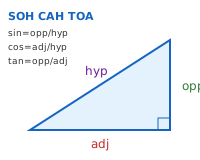
Every right triangle has one 90° angle. The angle you are working from is called the reference angle and is usually labelled θ ("theta" — a Greek letter that simply stands for an unknown angle, the way x stands for an unknown number). Relative to the reference angle, the three sides are named:
Hypotenuse (hyp): the longest side, always across from the right angle.
Opposite (opp): the side directly across from the reference angle.
Adjacent (adj): the side next to the reference angle (not the hypotenuse).
If you switch to the other acute angle, opposite and adjacent trade places — so always label the triangle from the angle you are working with.

7.2 The Pythagorean Theorem
Example 7.1 — Finding the hypotenuse
The legs of a right triangle are 5 cm and 12 cm. Find the hypotenuse.
Solution:
c² = 5² + 12² = 25 + 144 = 169
c = √169 = 13 cm
Example 7.2 — Finding a leg
A right triangle has hypotenuse 25 m and one leg 7 m. Find the other leg.
Solution:
b² = 25² − 7² = 625 − 49 = 576
b = √576 = 24 m
7.3 The Three Trigonometric Ratios (SOH CAH TOA)
| Ratio | Formula | Memory aid |
| sine | sin θ = opp ÷ hyp | SOH |
| cosine | cos θ = adj ÷ hyp | CAH |
| tangent | tan θ = opp ÷ adj | TOA |
Calculator check: make sure your calculator is in DEGREE mode (look for a small D or DEG on the screen). This is the number one source of wrong answers in this unit.
Choosing the ratio: mark the reference angle, label the two sides involved in the question (the one you know and the one you want), then pick the ratio that uses exactly those two sides.
7.4 Finding an Unknown Side
Example 7.3 — Using tangent
From a point 40 m from the base of a tower, the angle of elevation to the top is 35°. How tall is the tower?
Solution:
The 40 m is adjacent to the angle; the height is opposite. Use tangent.
tan 35° = h ÷ 40
h = 40 × tan 35° ≈ 40 × 0.7002 ≈ 28.0 m
Example 7.4 — Solving for the hypotenuse
A guy wire makes a 42° angle with the ground and is anchored so that it reaches a point 15 m up a pole. How long is the wire?
Solution:
The 15 m is opposite the 42° angle; the wire is the hypotenuse. Use sine.
sin 42° = 15 ÷ w
w = 15 ÷ sin 42° ≈ 15 ÷ 0.6691 ≈ 22.4 m
7.5 Finding an Unknown Angle
When you know two sides and want the angle, use the inverse functions: sin⁻¹, cos⁻¹, tan⁻¹ (usually 2nd or SHIFT plus the ratio key).
Example 7.5 — Finding an angle
In a right triangle, the side opposite angle θ is 8 cm and the side adjacent is 12 cm. Find θ to the nearest tenth of a degree.
Solution:
tan θ = 8 ÷ 12 = 0.6667
θ = tan⁻¹(0.6667) ≈ 33.7°
7.6 Angles of Elevation and Depression
The angle of elevation is measured upward from the horizontal (looking up at a rooftop). The angle of depression is measured downward from the horizontal (looking down from a cliff). Because horizontals are parallel, the angle of depression from the top equals the angle of elevation from the bottom — they are alternate interior angles, connecting this unit back to Unit 5.
Example 7.6 — Ladder safety problem
A 6 m ladder leans against a wall with its base 2 m from the wall. (a) What angle does the ladder make with the ground? (b) How high up the wall does it reach?
Solution:
(a) The 2 m base is adjacent; the 6 m ladder is the hypotenuse. cos θ = 2 ÷ 6 = 0.3333
θ = cos⁻¹(0.3333) ≈ 70.5°
(b) height² = 6² − 2² = 36 − 4 = 32 (Pythagorean theorem)
height = √32 ≈ 5.7 m
Unit 7 Practice Questions
Round sides to one decimal place and angles to the nearest tenth of a degree.
Find the hypotenuse of a right triangle with legs 9 cm and 12 cm.
A right triangle has hypotenuse 17 m and one leg 8 m. Find the other leg.
Find the side opposite a 30° angle if the hypotenuse is 20 cm.
Find the side adjacent to a 25° angle if the hypotenuse is 18 m.
Find the side opposite a 62° angle if the adjacent side is 50 m.
Find the hypotenuse if the side adjacent to a 40° angle is 24 cm.
Find θ if the opposite side is 7 cm and the hypotenuse is 14 cm.
Find θ if the opposite side is 9 m and the adjacent side is 4 m.
A wheelchair ramp rises 1.2 m over a horizontal run of 6.5 m. Find the angle of the ramp.
A kite is on an 85 m string that makes a 48° angle of elevation with the ground. How high is the kite (ignore the height of the hand holding it)?
Practice Final Exam
Time: about 2 hours. Scientific calculator allowed; no notes. Show your work for every question. Round money to the nearest cent, sides to one decimal place, and angles to the nearest tenth of a degree.
Unit Pricing and Currency Exchange (Questions 1–4)
A 2.5 kg bag of apples costs $7.25. Find the price per kilogram.
Granola bars come in a 6-pack for $4.74 or an 8-pack for $6.16. Which is the better buy? Show unit prices.
A $65.00 pair of shoes is discounted 20%. Find the total cost including 5% GST.
Convert 240 CAD to US dollars if 1 CAD = 0.75 USD.
Earning an Income (Questions 5–8)
Sam earns $19.00/h with time-and-a-half after 40 hours. One week he works 42.5 hours. Find his gross pay.
A salary of $47,840 per year is paid biweekly. Find the gross pay per cheque.
A salesperson earns $900 per month plus 3% commission on sales of $22,000. Find the gross monthly pay.
Tara’s gross pay is $1,400.00. Deductions are CPP 5.95%, EI 1.64%, and income tax 15%. Find her net pay.
Length, Area, and Volume (Questions 9–13)
Convert 15 ft to metres (1 ft = 0.3048 m).
Convert 195 cm to inches.
Find the perimeter of a rectangular deck 15.2 m by 9.8 m.
Find the area of a circular patio with diameter 14 m.
Find the volume of a cylindrical barrel with radius 4 cm and height 15 cm (nearest whole number).
Mass, Temperature, and Volume (Questions 14–18)
Convert 9.6 kg to pounds.
Convert 220 lb to kilograms.
Convert 68°F to Celsius.
Convert −12°C to Fahrenheit.
Convert 15 US gallons to litres.
Angles and Parallel Lines (Questions 19–22)
Find the complement of 19°.
Two parallel lines are cut by a transversal. One angle is 64°. Find its co-interior angle.
Two parallel lines are cut by a transversal. One angle measures 127°. Find its alternate interior angle.
A 74° angle is bisected. Find each resulting angle.
Similarity of Figures (Questions 23–25)
Two triangles are similar. Solve for x: x / 15 = 6 / 9
A floor plan uses scale 1:75. A room wall is 4 cm on the plan. Find the actual length in metres.
A 2 m pole casts a 2.5 m shadow while a building casts a 32 m shadow. Find the height of the building.
Trigonometry of Right Triangles (Questions 26–28)
Find the hypotenuse of a right triangle with legs 6 m and 8 m.
From a point 50 m from the base of a building, the angle of elevation to the roof is 38°. Find the height of the building.
A 12 m ramp rises 2 m. Find the angle the ramp makes with the ground.
Answer Key
Unit 1 Practice
$8.67 ÷ 3 = $2.89/kg
500 mL: $4.50 ÷ 5 = $0.90 per 100 mL. 750 mL: $6.30 ÷ 7.5 = $0.84 per 100 mL. The 750 mL bottle is the better buy.
$5.88 ÷ 12 = $0.49 per can
$34.99 × 0.75 = $26.24
$59.99 × 1.05 = $62.99
$22.00 × 1.45 = $31.90
350 × 0.73 = $255.50 USD
100 × 1.47 = $147.00 CAD
$120 × 0.85 = $102.00; $102.00 × 1.05 = $107.10
Discount = $20; $20 ÷ $80 = 0.25 = 25%
Unit 2 Practice
37.5 × $15.80 = $592.50
40 × $18 = $720; overtime 6 × $27 = $162; total $882.00
$58,500 ÷ 12 = $4,875.00
$61,200 ÷ 24 = $2,550.00 (semi-monthly = 24 pays)
0.04 × $55,000 = $2,200.00
$600 + 0.015 × $40,000 = $600 + $600 = $1,200.00
640 × $0.85 = $544.00
CPP = 0.0595 × 950 = $56.53; EI = 0.0164 × 950 = $15.58; tax = 0.15 × 950 = $142.50. Net = 950 − 214.61 = $735.39
8 × $15 = $120; $120 + $94.50 = $214.50
$22.40 × 40 × 52 = $46,592.00
Unit 3 Practice
84 ÷ 12 = 7 ft
3.2 × 1000 = 3200 m
6 ft 2 in = 74 in; 74 × 2.54 = 187.96 cm
250 ÷ 2.54 = 98.43 in
4 × 9.5 = 38 cm
C = 2πr = 2π(7) ≈ 43.98 m
A = (14 × 9) ÷ 2 = 63 cm²
r = 5 m; A = π(5)² ≈ 78.54 m²
V = 40 × 25 × 30 = 30,000 cm³
V = π(3)²(10) = 90π ≈ 282.74 cm³
SA = 2(20 × 15 + 20 × 10 + 15 × 10) = 2(300 + 200 + 150) = 1300 cm²
SA = 2π(4)² + 2π(4)(9) = 2π(16) + 2π(36) = 100.53 + 226.19 ≈ 326.7 cm²
Unit 4 Practice
3500 ÷ 1000 = 3.5 kg
6.8 × 2.2 = 14.96 ≈ 15.0 lb
180 ÷ 2.2 ≈ 81.82 kg
12 × 28.35 = 340.2 g
1.8 × 30 + 32 = 86°F
(350 − 32) ÷ 1.8 = 176.7 ≈ 177°C
1.8 × (−5) + 32 = −9 + 32 = 23°F
20 ÷ 3.79 ≈ 5.28 gallons
2.5 × 3.79 ≈ 9.48 L
6 × 0.946 ≈ 5.68 L
Unit 5 Practice
Obtuse (between 90° and 180°)
90° − 62° = 28°
180° − 45° = 135°
126° ÷ 2 = 63°
Co-interior angles are supplementary: 180° − 110° = 70°
Corresponding angles are equal: 110°
Alternate interior angles are equal: 110°
Vertically opposite angle = 65°; the other two angles are each 180° − 65° = 115°
x + 3x = 180, so 4x = 180 and x = 45. The angles are 45° and 135°
360° − 130° = 230°
Unit 6 Practice
k = 10 ÷ 4 = 2.5; sides are 6 × 2.5 = 15 cm and 8 × 2.5 = 20 cm
6x = 36, so x = 6
6.2 × 200 = 1240 cm = 12.4 m
480 cm ÷ 24 = 20 cm
h ÷ 9 = 1 ÷ 0.75, so h = 9 ÷ 0.75 = 12 m
k = 10 ÷ 4 = 2.5; long side = 6 × 2.5 = 15 in
5 × 2.5 = 12.5 cm and 8 × 2.5 = 20 cm
3.6 × 25 = 90 km
Yes. 9 ÷ 6 = 1.5 and 15 ÷ 10 = 1.5 — sides are proportional, angles all 90°
360 cm ÷ 30 = 12 cm
Unit 7 Practice
c² = 9² + 12² = 225; c = 15 cm
b² = 17² − 8² = 225; b = 15 m
opp = 20 × sin 30° = 20 × 0.5 = 10 cm
adj = 18 × cos 25° ≈ 16.3 m
opp = 50 × tan 62° ≈ 94.0 m
hyp = 24 ÷ cos 40° ≈ 31.3 cm
sin θ = 7 ÷ 14 = 0.5; θ = sin⁻¹(0.5) = 30°
tan θ = 9 ÷ 4 = 2.25; θ = tan⁻¹(2.25) ≈ 66.0°
tan θ = 1.2 ÷ 6.5 ≈ 0.1846; θ ≈ 10.5°
height = 85 × sin 48° ≈ 63.2 m
Practice Final Exam
$7.25 ÷ 2.5 = $2.90/kg
6-pack: $4.74 ÷ 6 = $0.79 each. 8-pack: $6.16 ÷ 8 = $0.77 each. The 8-pack is the better buy.
Sale price = $65 × 0.80 = $52.00; with GST = $52 × 1.05 = $54.60
240 × 0.75 = $180.00 USD
Regular: 40 × $19 = $760; overtime: 2.5 × ($19 × 1.5 = $28.50) = $71.25; gross = $831.25
$47,840 ÷ 26 = $1,840.00
$900 + 0.03 × $22,000 = $900 + $660 = $1,560.00
CPP = $83.30; EI = $22.96; tax = $210.00; total deductions = $316.26; net = $1,400 − $316.26 = $1,083.74
15 × 0.3048 = 4.572 ≈ 4.57 m
195 ÷ 2.54 ≈ 76.8 in
P = 2(15.2 + 9.8) = 2(25) = 50.0 m
r = 7 m; A = π(7)² ≈ 153.94 m²
V = π(4)²(15) = 240π ≈ 754 cm³
9.6 × 2.2 = 21.12 ≈ 21.1 lb
220 ÷ 2.2 = 100 kg
(68 − 32) ÷ 1.8 = 20°C
1.8 × (−12) + 32 = −21.6 + 32 = 10.4°F
15 × 3.79 ≈ 56.85 L
90° − 19° = 71°
180° − 64° = 116°
Alternate interior angles are equal: 127°
74° ÷ 2 = 37°
9x = 90, so x = 10
4 × 75 = 300 cm = 3 m
h ÷ 32 = 2 ÷ 2.5, so h = 32 × 0.8 = 25.6 m
c² = 6² + 8² = 100; c = 10 m
h = 50 × tan 38° ≈ 39.1 m
sin θ = 2 ÷ 12 ≈ 0.1667; θ = sin⁻¹(0.1667) ≈ 9.6°
Supplement Sections
These sections cover ADLC workbook topics that do not have their own heading in the main units. Read them when you reach the related unit, or review them before the combined final.
1.5 Percent Shortcuts and Comparing Sales
A 30% discount means you pay 70%. Multiply by (1 − 0.30) = 0.70. When comparing sales, use the final price after all discounts, not just the percent off.
Example 1.8 — Which sale is better?
Store A: 25% off a $80 item. Store B: Buy one get one 50% off on $80 items (you buy 2). Which is cheaper for 2 items?
Solution:
Store A: $80 × 0.75 = $60 per item → 2 items = $120. Store B: First $80 + second at 50% off = $80 + $40 = $120. Same price — check tax and quality.
1.6 Currency Exchange Estimation
- 1Round the exchange rate to an easy number (e.g. 0.74 → 0.75).
- 2Multiply to get a quick estimate.
- 3Use the exact rate for your final answer on tests.
2.5 Timesheets, Bonuses, and Paystubs
Timesheet basics: Add regular hours and overtime hours separately. Overtime is usually paid at 1.5× the regular rate after 40 hours (or 8 hours/day, depending on the job).
Bonuses: A one-time extra amount added to gross pay for that pay period. Tax is still deducted from the total.
Reading a paystub:
- 1Find Gross Pay (total earned before deductions).
- 2List each deduction: CPP, EI, income tax, union dues, etc.
- 3Add all deductions.
- 4Gross Pay − Total Deductions = Net Pay (take-home).
2.6 Tax Brackets and Voluntary Deductions
Exams usually give you the tax rate or deduction amounts. In real life, Canada uses tax brackets — different portions of income are taxed at different rates. Voluntary deductions (RRSP, charity, benefits) reduce take-home pay but are not required by law.
Example 2.7 — Paystub with voluntary deduction
Gross pay $1,500. Mandatory deductions total $320. A $50 charitable donation is also deducted. Find net pay.
Solution:
Net pay = $1,500 − $320 − $50 = $1,130.00
3.7 Nets and Extra Surface Area Shapes
A net is a flat pattern that folds into a 3-D object. To find surface area from a net, find the area of each face and add them.
- Pyramid: SA = base area + ½ × perimeter of base × slant height
- Cone: SA = πr² + πrs (where s is slant height)
- Sphere: SA = 4πr²
Your exam will give formulas if you need them.
3.8 Measurement Referents (Real-World Benchmarks)
Referents help you estimate without a ruler:
| Length referents | About how long |
| Width of your thumb | ≈ 2 cm |
| Width of a door | ≈ 1 m |
| Height of a door | ≈ 2 m |
| Football field | ≈ 100 m |
| Area referents | About how big |
| Piece of paper | ≈ 600 cm² |
| Tennis court | ≈ 260 m² |
| Classroom floor | ≈ 50–80 m² |
5.4 Midpoint
The midpoint of a line segment is the point exactly halfway between the two endpoints.
Midpoint formula: M = ((x₁ + x₂)/2, (y₁ + y₂)/2) for coordinates. Or: midpoint length = total length ÷ 2.
Example 5.4 — Finding a midpoint
A wall is 4.8 m long. Where is the midpoint?
Solution:
Midpoint = 4.8 ÷ 2 = 2.4 m from either end.
5.5 Referent Angles and Construction
Referent angles (benchmarks for estimating):
- Corner of a square = 90°
- Half a square corner = 45°
- Each hour on a clock = 30° (360° ÷ 12)
Bisecting with compass and ruler: Place compass on the vertex, draw an arc crossing both arms. From those two points, draw equal arcs that cross. The line from the vertex through that crossing bisects the angle.
6.4 Constructing Similar Polygons and Floor Plans
To draw a similar polygon with scale factor k:
- 1Measure each side of the original.
- 2Multiply every side by k.
- 3Draw the new shape with those lengths. Keep all angles the same.
Floor plans use a scale like 1:50 or 1:100. Actual length = drawing length × scale number (when units match).
Example 6.5 — Floor plan scale
A room is 6 cm long on a 1:75 floor plan. Find the actual length in metres.
Solution:
Actual = 6 × 75 = 450 cm = 4.5 m
7.7 The 3:4:5 Triangle and Maps
If a triangle has sides in ratio 3:4:5, it is a right triangle. Builders use this to check corners are square.
Example 7.7 — Is it a right triangle?
A triangle has sides 9 m, 12 m, and 15 m. Is it a right triangle?
Solution:
Check: 9² + 12² = 81 + 144 = 225 = 15². Yes — it is a right triangle (3:4:5 × 3).
Example 7.8 — Map distance
On a map, 1 cm represents 500 m. Two towns are 3.5 cm apart on the map. Find the actual distance in km.
Solution:
Actual = 3.5 × 500 = 1750 m = 1.75 km
7.8 Angles of Elevation and Depression
- 1Draw a horizontal line from the observer's eye.
- 2Draw the line of sight to the object.
- 3Label the angle — elevation if looking up, depression if looking down.
- 4Set up SOH CAH TOA using the right triangle formed with the horizontal.